
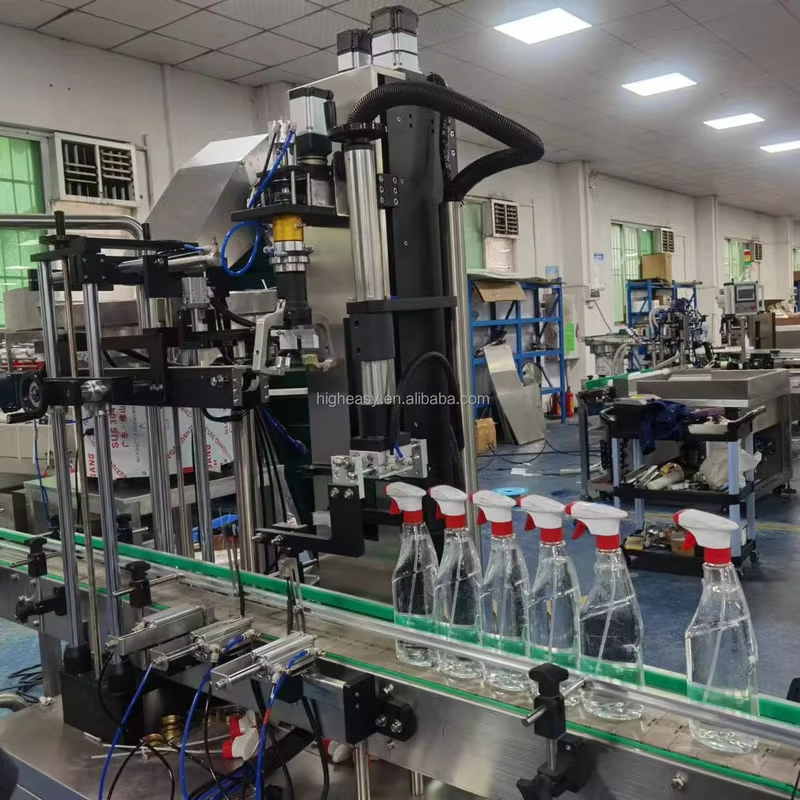
Filling Inaccuracies and Material Handling Issues
Deviation in volumetric accuracy and filling inconsistency
Filling inconsistency represents an annual loss of $740k in giveaway products due to regulatory non-compliance and affects 23% of automated packaging lines (Ponemon 2023). The behavior of fluids changes due to viscosity and temperature shifts; load cell calibration drift introduces metering deviations of ±2% and even more. Periodic validation of the nozzles in conjunction with dynamic viscosity compensation methods maintains fill accuracy within tolerance of ±0.5% for all product batches.
Leakage, dripping, premature retraction, or filler seals and timing defects
Premature nozzle retraction causes dripping in 17% of cycles, contaminating sealing surfaces, thus risking cap adhesion failure. The piston seals backflow during the transfer/pouring phase, and misalignment of the sealing sequence leads to partial filling of spouts. According to peer-reviewed studies on packaging efficiency, the use of pressure-sensitive shutoff valves and real-time monitoring of seal integrity defects reduce leakage incidences by 68%.
The flow of filling materials in a consistent, non-pulsing manner
Entrained air in the vacuum lines causes surging flow and results in underfilling of pouches by 12-15%. Pump cavitation with high viscosity products causes strain to the drive system due to the intermittent flow. The use of integrated load sensors and variable-speed drives (VFD), along with automated inline degassing, promotes the elimination of bubbles prior to filling.
Capping Failures and Torque-Related Defects
The lack of controlled consistent torque is a top-line problem leading to seal failure and product safety concern in the spout pouch business. 40% of packaging defects of liquid food products are attributed to under- or over-torquing caused during a packaging process, due to a combination of lack of appropriate calibration, mechanical factors, or misalignment of components.
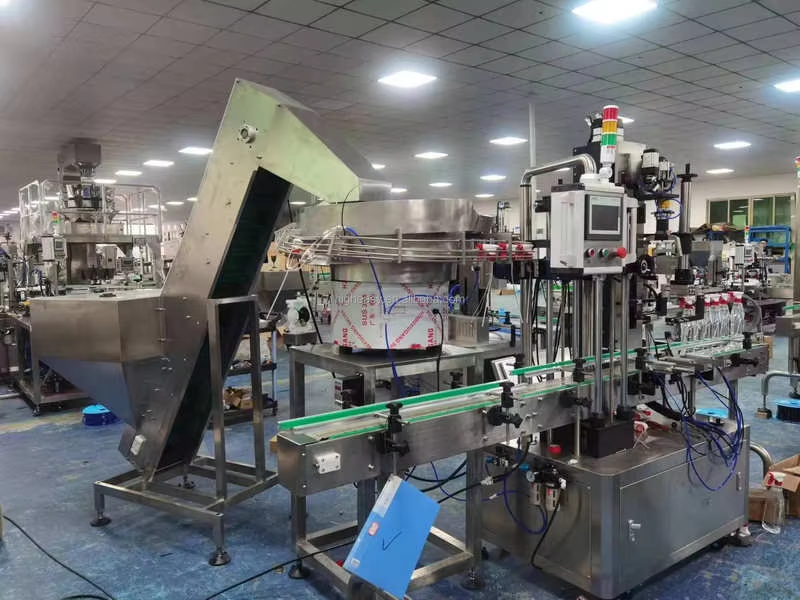
Loose or under-torqued caps can cause product leakage or compromise their shelf-life
Clamping with insufficient force means that caps are unable to form a complete a seal, meaning that oxygen can penetrate the product, leading to the growth of microorganisms. In the case of oxygen-sensitive products such as dairy or juice, spoilage can occur faster, noticeably reducing shelf-life (Packaging Stability Consortium, 2022). Leakage during transport only increases the product loss. The average recall cost due to such leakage is estimated to exceed $740k (Ponemon 2023). Digital torque verification systems are designed to apply torque within an optimal range of 0.5-2.5 Nm in a consistent manner for the majority of spout pouch designs.
Torque-related defects such as thread stripping or misaligned caps
Torque in excess of the designed limit will lead to deformation of polymer threads and compromise the tamper-evident features; misaligned capping heads will lead to a cross-thread and can render packages unopenable, or will lead to during the product's shelf-life. Laser-guided alignment systems, together with servo-controlled torque systems, reduce the number of force-related defects even at high speeds by 90%.
Type of defect Cause Prevention
Under-torquing Worn clutch mechanisms Monthly calibration
Over-torquing Incorrect pressure settings Servo feedback
Crooked caps Misaligned feed rails Vision-guided adjustments
Table 1: Typical torque-related defects and their mitigation strategies for spout pouch systems.
Challenges with pouch feeding and spout compatibility
Challenges with premade spout pouch misfeeding, jamming, or misalignment at the filling station.
Pouch misfeeding and jamming is caused by the material used for pouches and inconsistent tapering of the pouches. ®nd a synchronous conveyor. A deviation of even ±1.5mm of a design specification can result in a misalignment rate of 32% (Packaging Digest 2023). This, in turn, leads to a seal and nozzle mismatching, causing unplanned downtime of about 45 minutes per incident. The systems that are designed to prevent this are based on servo-controlled feeding systems that use real-time tension measurement, and rapid continuous sampling of the incoming pouch stock.
Problems with material stiffness, spout geometry, or seal design
A combination of laminate rigidity, atypical spout tapering, and narrow seal flanges leads to predictable failure modes.
Compatibility Factor Failure Risk Proposed Solution
Laminate stiffness 68% seal integrity loss Increase pre-heating temperature by 5°c
Spout tapering 40% capping torque failures Guide design to match spout geometry.
Seal flange width 57% leakage failures Dynamic pressure adjustments
Barrier layers thicker than 120μm and atypical spout designs are problematic in achieving uniform cap-sealing and are estimated to create ~14% misalignment in pouches. Correcting these parameters in the early stages of design, as opposed to retrofitting in production, reduces compatibility-related downtime by 74% .
Reliability and Preventive Maintenance
Unplanned downtimes in spout pouch filling and capping operations have been estimated to exceed $740k annually (Ponemon 2023), and are notably less as a result of a singular breakdown, but more from the absence of scheduling routine maintenance including adjustments of calibrating, lubrication, and wear detection. Reliability-based maintenance, combined with routine scheduled adjustments of control sensors, lubrication of the capping head, and regular inspections of vacuum seals, mitigates the impact of minor wear-related factors to prevent them from becoming significant line stoppages. When combined with predictive maintenance practices such as the use of vibration analysis on conveyor motors and thermal imaging on pump housings, it allows the early identification of wear mechanisms to avoid loss of function. This comprehensive approach to maintenance results in significant improvements to Overall Equipment Effectiveness (OEE) by reducing operable but inefficient cycles, ensuring the quality of the pouches, and maintaining consistent production rates. Manufacturers implementing these practices are able to extend the service life of their equipment, avoid expensive product recalls, and reliably meet high standards for quality and compliance.
Frequently Asked Questions (FAQ)
What factors contribute to the inconsistent fill volumes observed in packaging lines?
The fill volume for an individual container can vary because of a combination of effecting factors such as: changes in viscosity, temperature, and load cell drift all significantly influence the behavior of the fluid flow, leading to fill volume inconsistencies.
What are some ways to reduce dripping nozzles in packaging?
Implementing pressure sensitive shutoff valves and monitoring the integrity of the seals in real-time can reduce dripping nozzles, as they eliminate the issues of premature retraction of the nozzles and fault seals.
What are some ways to reduce packaging defects?
Using digital torque verification, laser alignment, and servo driven torque controllers can help reduce packaging defects by ensuring packaging is done correctly.
What are some ways to reduce the issues related to material compatibility?
Considering laminate material, notch and angle of the spout, and the flange width during the initial pouch design will help minimize the material compatibility challenges.
What is the importance of preventive maintenance in improving operational reliability?
Scheduled preventive maintenance, such as lubrication and calibration, keeps the equipment performing optimally, thus, improving operational reliability and reducing the likelihood of unplanned downtime.