
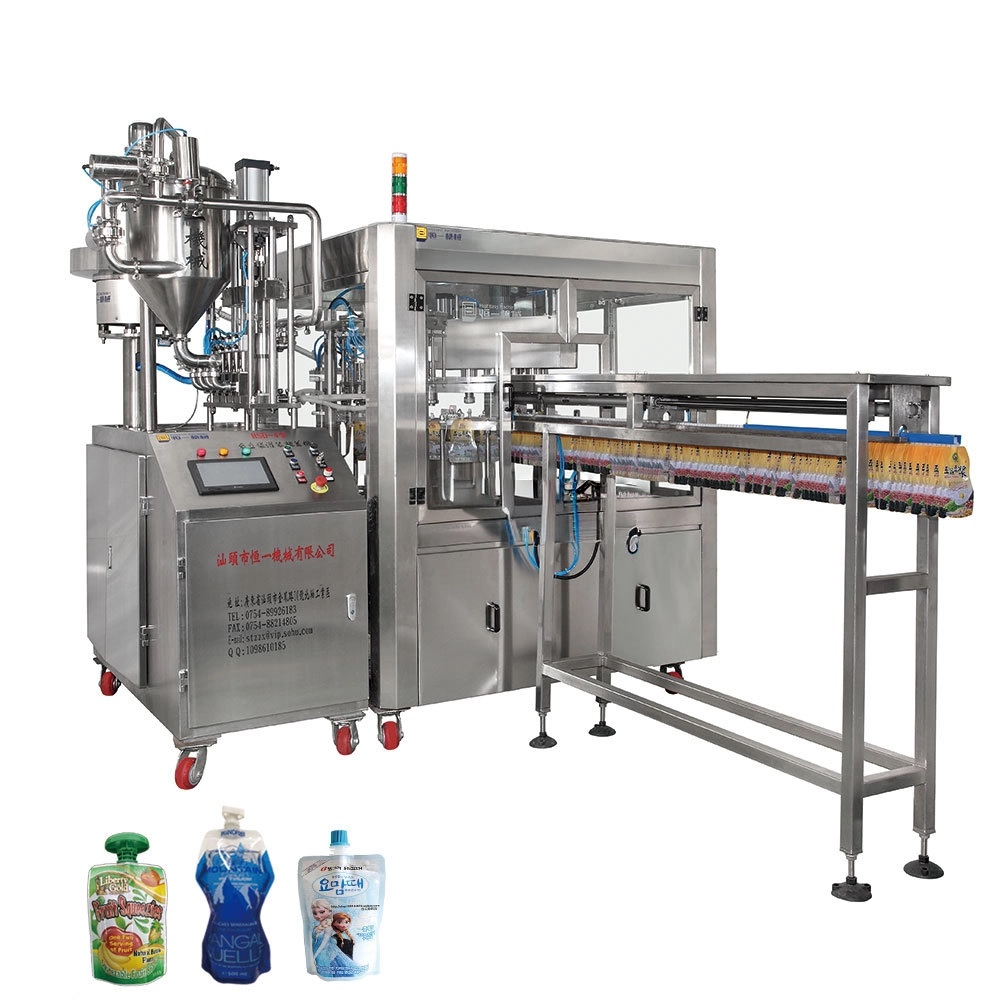
Why Specialty Products Demand Specialty Formulations for Spout Pouch Filling Technology
Common Spout Pouch Filling Technology Ignores Fluid Diversity
Common spout pouch filling and capping machines are designed for mass-produced commodity formulations only. Within three critical constraints, standard systems generally perform poorly:
High, low, and variable fluid viscosity: Filling devices for high viscosity products like honey or edible butters that are 50,000 cP or greater, use positive displacement pumps. Conversely to filling fluids like CBD oil, require vacuum-assisted laminar flow nozzles to avoid drip, both technologies are absent in general systems.
Fluids that are thermally unstable: Thermally variable active materials such as probiotics, enzymes, and other live cultures, deteriorate if the temperature varies by more than 1°C. Typical heat exchangers do not have the fine control to stay within this narrow band during a filling.
Thermal fluid integrity: Specialty products that are aseptic or sterile require Class ISO 5 cleanroom and validated CIP/SIP systems. 80% of standard machines lack these systems as per industrial benchmarking data (PMMI, 2023).
Without modular, specially designed components, manufacturers have to live with product spoilage, not meeting FDA 21 CFR Part 117 or EU Annex 1 and costs of product recall, 740,000 (Ponemon Institute, 2023).
Failures Caused By Generic Equipment: CBD Oil Dripping, Honey Stringing and Serum Foaming
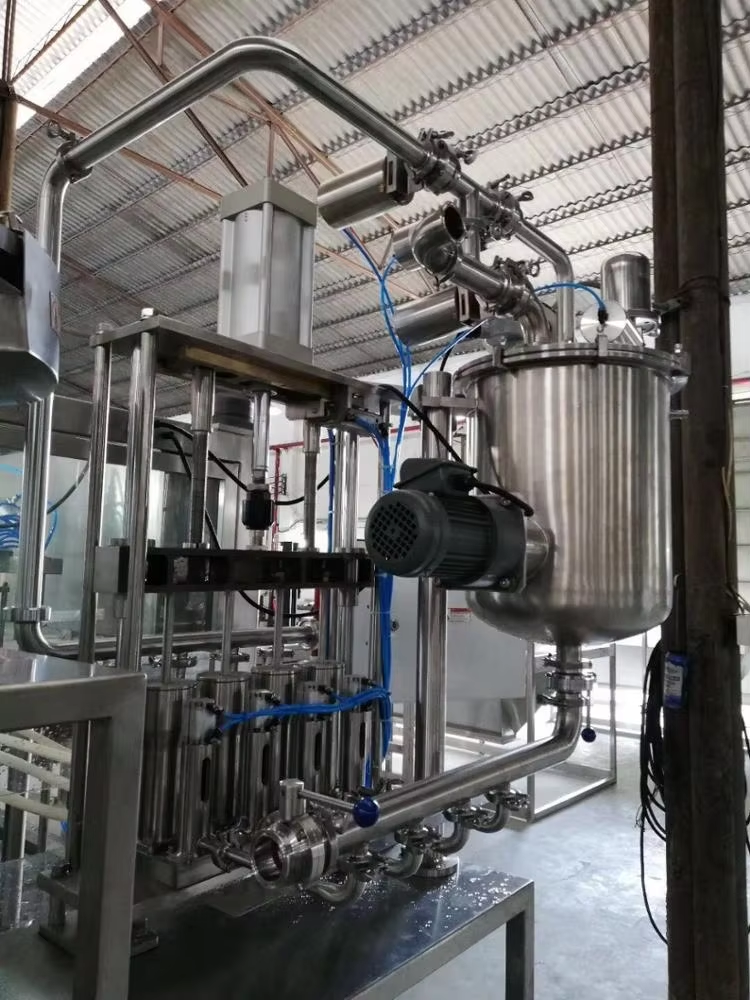
Generic equipment typically results in failing situations that disrupt a fluid line due to principal material science based non-compliance:
CBD Oil: The standard nozzles lack laminar flow control and the drip loss of product post filling is 15%.
Vitamin C Serum: High shear rotary piston fillers oxidize the L-ascorbic acid, shortening shelf life.
Honey: The stringing, crystallization, and premature nucleation clog the spouts and disrupt the lines.
These concerns identify a notable void. While pseudoplastic and thixotropic fluid behaviors deviate from Newtonian fluid behavior, these non-Newtonian fluid behaviors necessitate a system capable of real-time, rudimentary rheological adjustments. Torque sensitive capping heads address these unique voids, though without these features, the caps are fragile, with the serum caps either breaking, or the cap having too little torque, leading to a compromise of the system’s theoretical zero capacity sterility and seal integrity.
Pragma's Machines - your suction Spout Pouch Filler and Capping Machines' Custom Engineer Solutions
(More to come, i.e. Spout Capping Solutions and each division thereof. Customization, Expansion, Optimization, Relocatable Spout Multip worksheets.)
Controlled Fluid Dynamics: Modular Gear Pumps and Replaceable Spout Nozzles
Fluid paths that share a singular characteristic compromise the accuracy of the system and yield value. Replaceable spout nozzle design feature swift, tool-free operational changes, and pumped fluid nozzles provide molded low-shear fins that increase the efficiency of the system. With this system, along with the modular gear pumps, the targeted and controlled displacement results in slow 0.2 L/min for a 300 cP cosmetic emulsion and high-torque, high-shear displacement for 1,500 cP ketchup. From the systems surveyed, these modular gear pumps stand apart for the ability to provide flexible in-situ adjustments, controlled changes to shear rate and displacement, and real-time changes to back pressure.
Torque-sensors controlled Capping heads and the Spout-Cap Interface Modules provide Intelligent Capping Technology Adaptations
Capping irregularities and the related quote create 17% of failures associated with specialty products. These failures stem from the over-torquing of the brittle, polymer neck of the spout, which resulted in the deformation of the spout, and from the retainer insert melting, and the threaded caps slowly leaking the product. Torque-controlled Capping heads provide program-controlled torque and rotational force, and provide active torque financial guarantees based on the varying materials, spatial geometrical cap threads, and the thicknesses of the spout wall, from 0.5 to 5.0 Nm.
Industry-tailored Smart Control & Integration System Upgrades
Precision Control PLC Parameter Tuning for ±0.5 mL, 20-120, and Aseptic
Specialty Packaging is not a 100% mechanical function, it is also an algorithmic function. Programmable Logic Controlled Packing, with integrated models of rheology and thermal compensation, allow for the precise control of the speed and viscosity parameters of a fluid system. The PLC control system also has the ability of real time control via an intuitive touch screen interface, which allows for the operator to set viscosity, retraction, and dwell time to the prescribed ±0.5 mL accuracy for a system with 100,000:1 viscosity range. The speed parameter also has a range between 20-120 pouches per minute, which allows the operator to control the flow of a high viscosity fluid, and for both small and large volume packings, without changing any of the hardware. Most importantly, aseptic control logic allows for automation of sterilization and ramping control, as well as controlled environmental parameters to allow for validated and repeatable runs for individual requirements set forth by the FDA and EMA. The control and integration systems are able to reduce set-up time by 70% in comparison to the mechanical systems alone.
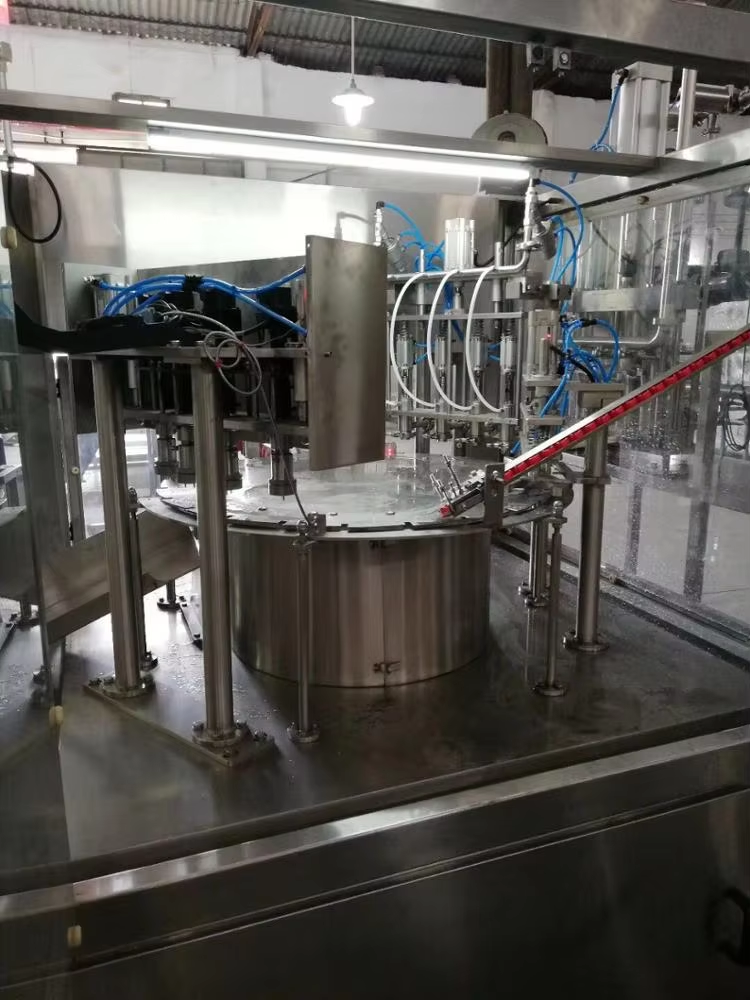
Real World Examples: One Spout Pouch Line, Energy Drink and Sauce Combination
The economical choice of an intelligent custom system is proven by the control of both carbonated energy drinks and viscosity tomato sauces from a single spout pouch line. To retain the inline carbonate from the sauce, the energy drinks required high speed, low shear filling, while the sauce required low speed, heated pathways to retain pumpability and reduce spout clogging. The control of the system also has three integrated systems:
Adaptive Viscosity Pump from PLC real-time feedback to control fluid shear reward to one of two settings;
Adaptive Spout Capping, which automatically controlled the fit for the filling spouts.
Automated, Inter-Pet FIFO sanitation via control of the CIP (Cross Interchange Pump) of the filling system, resulted in no product cross-contamination.
Our hybrid lines have a changeover time 70% lower compared to dedicated lines, and maintain a volumetric accuracy of ±0.5% for both products. This innovative engineering of our hybrid spout pouch lines has resulted in a 35% increase in equipment utilization, and a 2.1 year return on investment for customized engineering, as systems have been transformed from a static flexible asset, to an a ready-to-compliance dynamic flexible asset.
FAQ
What is the reason for the inability of regular spout pouch filling and capping machines to handle specialty products? Standard machines are designed for uniform products and lack the configurability to manage specialty products.
What are the filling line problems and challenges encountered when filling jars of CBD oils, serums, and Honey using generic equipment? CBD oil line failures are experienced due to laminar flow, the line incorporates shear and results in the foaming of serum, and honey crystallizes due to uncontrolled line temperature.
What are potential methods for improving the filling accuracy of specialty products? The filling accuracy for specialty products may be improved by increasing the modularity of filling line gear pumps, the inclusion of multiple interchangeable nozzles, and the use of more powerful PLCs to incorporate numeric control to filling lines.