
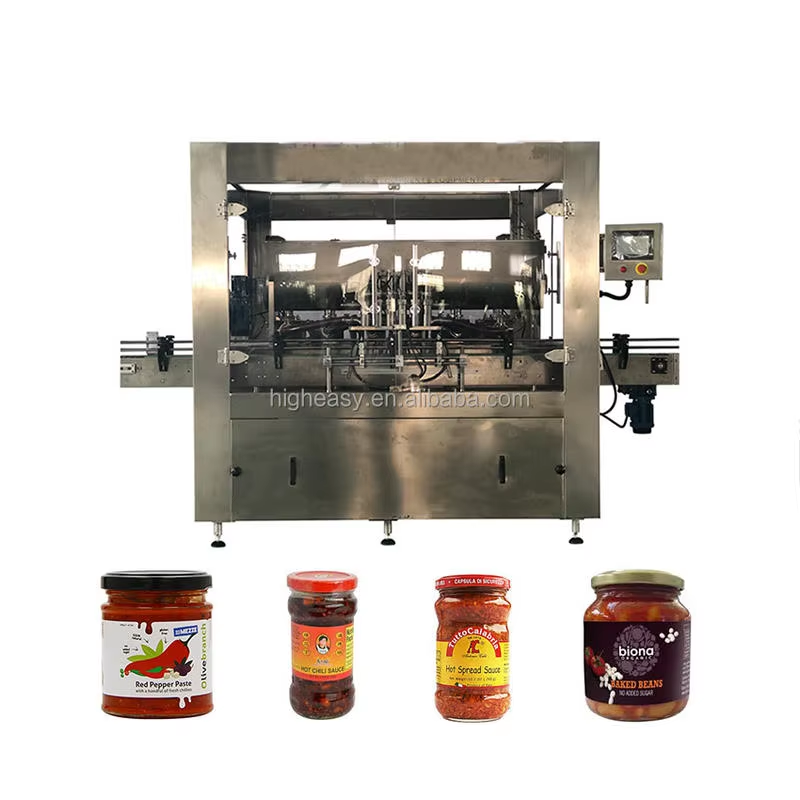
Cost-Benefit Considerations for a Spout Pouch Filling and Capping Machine
Initial Investment vs Total Cost of Ownership (TCO)
Generally, automatic spout pouch filling and capping machines are priced between $50,000 and $200,000, depending on speed, integrated precision features, and production line integration. When considering Total Cost of Ownership (TCO), automatic filling and capping machines become a smart financial decision. With automatic machines, labor costs are reduced by 60%, and product waste from filler inconsistency is eliminated. Automated machines are constructed of durable industrial components which reduces maintenance. Industry data demonstrates companies, on average, experience 20-30% savings on TCO after 5 years relative to semi-automatic machines. Considering future expansion, automatic systems are a smart investment relative to high initial costs.
Full Automation
Systems that are fully automated take over tasks such as pouch loading, spout alignment, container filling, capping, and quality control. This removes several manual positions, consolidating the labor to only one person who manages supervision and problem solving as they arise. For medium sized production facilities, labor savings alone translates to an average of $100,000 in costs. Even more savings are realized when factoring in reduced costs associated with training, error corrections, and downtime during shifts. It is not uncommon for companies to recoup their automation costs in as little as 1 year, and as long as 3 years. Machines are also able to work non-stop at maximum capacity producing more goods and requiring no additional personnel. This is most beneficial to larger scale manufacturers that need to sustain production as demand continues to increase, and keep profits growing sustainably.
Improvements in throughput, accuracy of filling, and consistency of filling
Current fully automated production lines have the ability to complete over 100 pouches/ minute, almost 2x the capacity of most semi-automated production lines. Filling is also quite consistent, with filling deviations of only about 0.5 % between batching. This level of accuracy greatly reduces product waste, saving businesses about 15 % on filling materials annually. When it comes to the processes of sealing and capping, modern systems apply the exact pressure to ensure that nothing is under sealed, over sealed or misaligned. A seal that is properly applied will protect the product while on retail shelves, ensure full compliance with regulations and requirements, and protect the trust of consumers in the brand. When the systems are accurate, businesses experience less consumer complaints, less packaging material returned to the warehouses, and more protection on the bottom line when market conditions fluctuate.
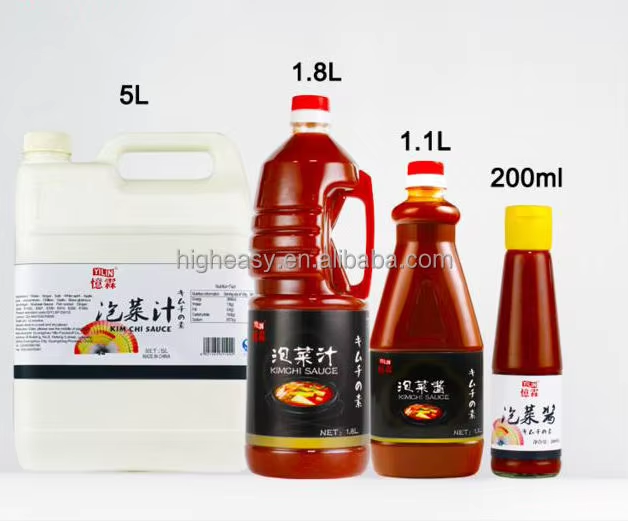
Operational Advantages: Hygiene, Reliability, and Seamless Automation
Contamination Controlled with Sterile Handling in Fully Automatic Spout Pouch Filling and Capping Machines
Fully automated systems offer a clear benefit: reduced contamination risks, sometimes as much as 98% compared to manual or semi-automated systems. These systems form a fully enclosed sterile area with positive pressure and automated in-process cleaning systems to help manufacturers meet the difficult requirements of FDA 21 CFR Part 11 and EU GMP guidelines for pharmaceuticals, dietary supplements, and premium food products. Numerous case studies illustrate the clear benefits of these systems. After implementing these systems, the pharmaceutical industry reports achieving a batch consistency of approximately 99.7%. The healthcare and dietary supplement industries also report a significant reduction in product recalls and production quality costs.
Uptime, Mean Time Between Failures (MTBF), and Maintenance Efficiency
Systems with solid state controls, wear resistant materials, and sensors that back up controls, MTBF is well over 2,500 hours. The best systems can run 95% of the time, with failures occurring infrequently. The modular design of these systems allows the technician to access components and materials that repair and replace rapidly. Compared to previously obsolete systems, these systems decrease scheduled maintenance by 40%. The systems of today include predictive maintenance diagnostics. The diagnsotic systems monitor the performance of servo motors, pneumatic systems, and the wear of nozzle components. The system diagnostics evaluate the operational status of the components and issue failures prior to total collapse. This predictive maintenance saves $18,000 annually per production line. Extending the useful life of the system 3 to 5 years is an economic life extension. Shifting our focus to predictive maintenance diagnsotic systems, will yield the greatest return on investment.
System Integration Capabilities and Production Scalability
Pre-filled Spout Pouch Filling and Capping
The integration of all steps in the spout pouch manufacturing systems where spouts are inserted, filling occurs, and sealing happens, all in one process, without the need for laborers to transfer products between processes, creates a much cleaner environment that operates with greater speed and a spout pouch process. When moving from stand-alone equipment to a fully integrated spout pouch process, companies see contamination reduced upwards of 70% and their equipment efficiency improves 40% over previous levels. The integrated design is flexible to accommodate future growth as a plant’s production requirements expand. Production doubling does not necessitate a complete redesign of the plant’s layout or construction of a second identical line. The systems seamlessly integrate with existing conveyors and labeler in/out systems for a faster integration than most expect. The most notable advantage of the systems is the filling consistency. The systems fill a wide range of viscosity products at a high speed range from 5,000 to 50,000 pouches per hour with fill accuracy within 0.5% regardless of fill product viscosity. The versatility of the systems is what manufacturers desire, not to be left with obsolete equipment.
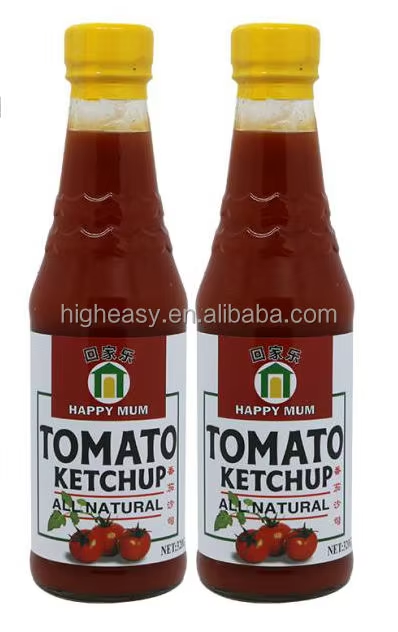
Your Spout Pouch Filling and Capping Machine Key Selection Criteria
The Automation Level vs the Product Viscosity, Pouch Type, and Volume
Ensuring the proper fit of the packaging machine revolves around these three factors. The first one, and most important, is the product. Liquid packaging is simple, and a gravity nozzle is enough. However, packaging viscous liquids (sauces, shampoos, and etc) requires a more advanced solution. In this case, piston or servo pumps should be integrated to ensure accuracy and to avoid drips. The format of the pouch also has other requirements. The vertical and horizontal positions of the spout, single plastic layer pouches, aluminum laminated pouches, and the shape of seals determine the purpose and fit of individual parts and assembly of the machine. The production speed is also important. If the operation is smaller than a target of 50 000 pouches in a month, semi-automatic machines will be enough. However, once the output reaches around 200 000 pouches, fully automated systems with robots should be employed. Poor fits will incur problems. Too few and empty packages, broken seals, and frequent machine stoppages are a result of underspecified, while wasted money on an expensive solution is put to use on an overspecified solution. Look for machines that will keep filling, with a consistent error of half a percent, for all packaging size and production throughput.
FAQ
How much can I expect to pay for spout pouch filling and capping machinery?
Depending on how fast and how precise your machinery needs to be, initial costs for an automatic spout pouch filling and capping machine can be anywhere from $50,000 to $200,000.
How do automatic systems save on labor and make it possible to see an ROI?
Automatic systems save on labor by taking over pouch loading, spout positioning, and quality inspection. Because labor costs can be reduced so much, the payback period can be less than or equal to three years.
What about throughput and accuracy for fully automatic lines?
Lines that are fully automatic can achieve a throughput of over 100 pouches per minute and have fill accuracy of 0.5%, which reduces the costs of material for filling.
Why are the hygiene and contamination improvements with automated systems?
Contamination of products can be reduced by 98% because automated systems reduce the human contact and Environment enclosed with automatic systems cleaning cycles
What are the challenges of maintenance with automated systems?
Less time, costs, and maintenance are required when compared to older systems. These systems have less downtime.