
How PLC Control Enables Integrated Spout Pouch Filling and Capping
Synchronized Workflow: From Filling and Spout Insertion to Heat Sealing and Capping
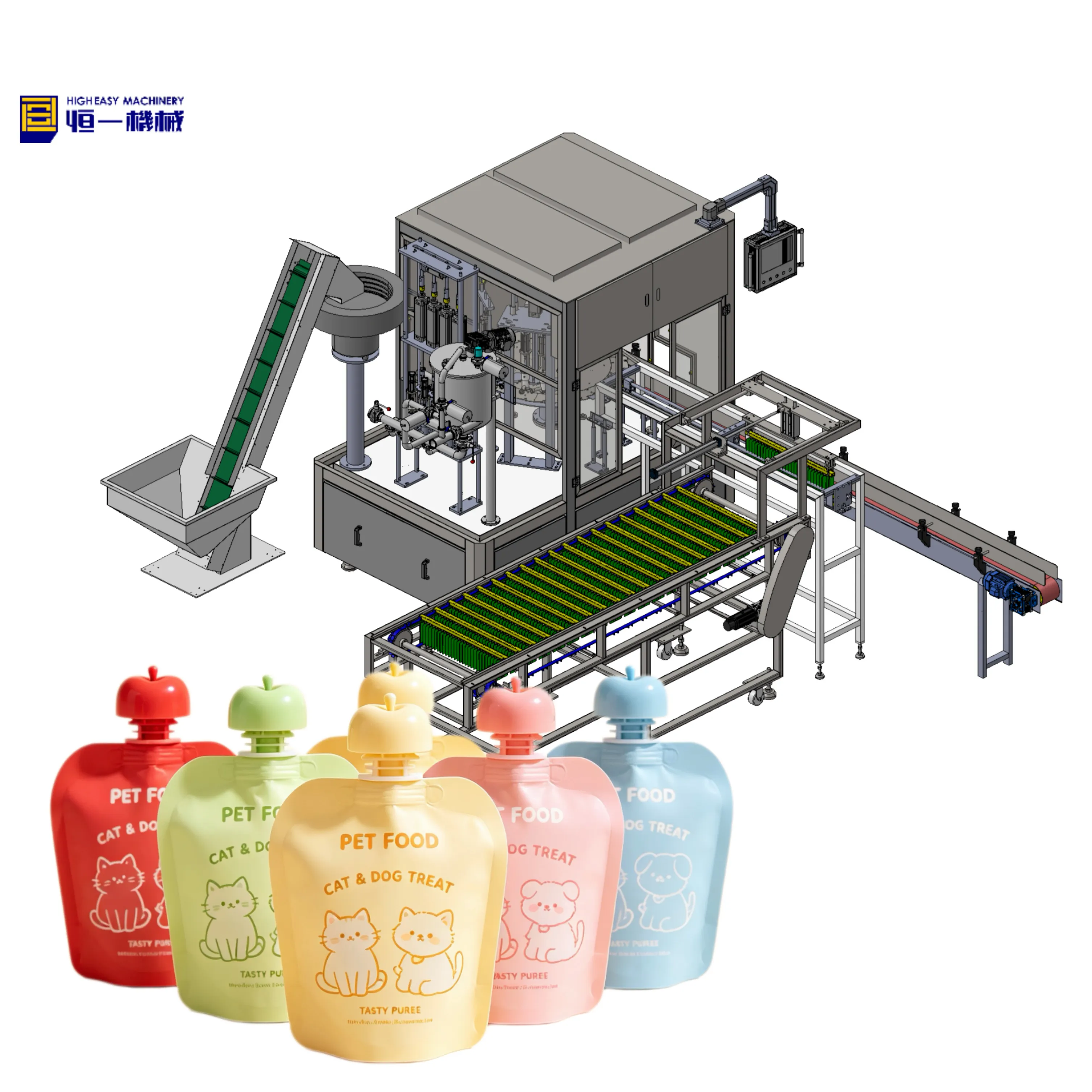
A modern spout pouch filling and capping machine relies on a central PLC to orchestrate each station with millisecond precision. The sequence begins when empty pouches are fed into rotary or linear grippers; the PLC triggers the filling nozzle to descend, dispense product, and retract—all while a servo-driven mechanism aligns the spout for insertion. Immediately after filling, the pouch indexes to the heat-sealing station, where the PLC manages seal-bar temperature, pressure, and dwell time within ±1°C tolerance, ensuring hermetic seals across diverse film structures. The final step is automatic capping: a torque-controlled spindle applies a preset closure force—typically 0.5–2.5 N·m—verified by encoder feedback. This seamless handover eliminates the lag and variability of relay-based systems, reducing cycle time by up to 20% compared to mechanically timed machines. By integrating filling, spout insertion, sealing, and capping into a single continuous motion profile, the PLC cuts manual intervention and raises throughput to 40–60 pouches per minute for typical 250–500 ml packs.
Real-Time Process Monitoring and Closed-Loop Adjustment via PLC Logic
PLCs transform spout pouch lines into self-correcting systems through continuous sensor feedback. Flow meters and load cells capture fill volume data 50–100 times per second; if the PLC detects a drift beyond a 0.5% target deviation, it automatically adjusts the pump stroke or valve timing to restore accuracy. Similarly, torque transducers at the capping head feed real-time values to the logic controller, which compares them against the recipe and instantly compensates for cap-seal compression variations. This closed-loop control extends to thermal regulation: thermocouples at the seal bar relay temperature readings, and the PLC modulates heater output to maintain the optimal sealing window even during cold starts or ambient shifts. The result is a documented 30–40% reduction in rejects and a 40% decline in unplanned downtime, as reported in a 2023 analysis of integrated packaging lines. Operators can visualize these loops on an HMI, allowing them to fine-tune thresholds and receive alerts—but the PLC enforces corrections autonomously, guaranteeing consistent quality without constant human oversight.
Key Automation Features of Modern Spout Pouch Filling and Capping Machines
Servo-Driven Precision for Fill Volume, Spout Alignment, and Cap Torque Control
Servo motors drive the dosing pumps, spout grippers, and capping heads, giving the machine exceptional accuracy. Closed-loop feedback constantly adjusts fill volumes, often achieving ±0.3% repeatability—slashing product giveaway while ensuring compliance with net-content regulations. Spout alignment is equally critical: servo-controlled grippers position each spout before heat sealing, preventing skewed closures that could leak. During capping, the same servo-centric approach delivers uniform torque on every cap; torque feedback loops instantly correct deviations, so caps seal tightly but never strip threads. Together, these functions eliminate the variability of pneumatic or manual systems—raising throughput, quality, and hygiene without increasing operator workload.
Recipe Management and Fast Changeover for Multi‑SKU Spout Pouch Production
Modern PLCs store complete recipe sets for different pouch sizes, fill volumes, spout types, and cap torques. An operator can recall a recipe with a single touch, and all servo axes automatically reposition. Changeover times often drop below 15 minutes—even when switching between wildly different SKUs. Recipe management also enforces validated settings, preventing human error during setup. Barcode-scanned job orders can trigger the correct recipe automatically, linking each production run to its parameters for traceability reports. Because mechanical adjustments are servo-driven, tool-free changeovers are standard. This flexibility lets a single line handle diverse products—from thin juices to viscous pastes—in short runs or long campaigns, supporting the agile manufacturing required in today’s consumer markets.
Industrial Network Integration: Modbus, EtherNet/IP, and OPC UA Support
Seamless MES/SCADA Connectivity for Traceability and OEE Tracking
Modern spout pouch filling and capping machines leverage industrial communication protocols—including Modbus TCP, EtherNet/IP, and OPC UA—to integrate seamlessly with plant-wide MES and SCADA systems. Modbus provides straightforward connectivity for legacy equipment and sensors, while EtherNet/IP delivers high-speed, deterministic control essential for synchronized operations. OPC UA, with its platform-independent, secure framework, enables the machine to expose production data—such as fill volumes, cap torque, and batch IDs—directly to higher-level systems. This connectivity supports real-time traceability from raw material lot to finished pouch and facilitates automatic OEE tracking by capturing availability, performance, and quality metrics. By feeding accurate, time-stamped data into MES, manufacturers can monitor utilization, identify bottlenecks, and generate compliance reports without manual entry—improving operational visibility and audit readiness. This integration transforms the machine into a data-generating asset, enabling predictive maintenance and continuous improvement.
Market Validation: Leading OEMs and Real-World Deployment of PLC-Based Spout Pouch Filling and Capping Machines
The market for spout pouch filling and capping machines has shifted decisively toward PLC-controlled automation, as evidenced by the product portfolios of leading packaging equipment manufacturers. These top OEMs now offer fully integrated PLC-based systems that combine filling, spout insertion, heat sealing, and capping into a single, synchronized line. Real-world deployments span food and beverage, personal care, and household chemical sectors—where high-speed, multi-SKU production is essential. In regions with expanding food processing industries, such as the Middle East and Africa, investments in modern automated packaging lines have accelerated adoption. Users report measurable gains in OEE, fill consistency, and changeover speed. With proven reliability in 24/7 operations and support for diverse pouch formats, PLC-based filling and capping solutions have become the benchmark for scalable, flexible packaging operations.
FAQ
What role does the PLC play in spout pouch filling and capping machines?
The PLC acts as the central control system that synchronizes the machine's operations, including filling, spout insertion, heat sealing, and capping, ensuring precision and efficiency.
How does closed-loop control improve product quality?
Closed-loop control continuously adjusts parameters such as fill volume, capping torque, and seal bar temperature based on real-time sensor feedback, reducing variability and enhancing consistency.
Can these machines handle multiple product types and sizes?
Yes, modern PLC-based machines support recipe management for multi-SKU production and enable quick changeovers to accommodate different pouch sizes, fill volumes, and product viscosities.
What benefits does industrial network integration provide?
Industrial network protocols like Modbus, EtherNet/IP, and OPC UA facilitate connectivity with MES and SCADA systems for traceability, OEE tracking, and predictive maintenance.
Why are servo motors used in spout pouch machines?
Servo motors provide precise control for tasks like dosing, spout alignment, and capping, enhancing accuracy while reducing variability and operator workload.
Table of Contents
- How PLC Control Enables Integrated Spout Pouch Filling and Capping
- Key Automation Features of Modern Spout Pouch Filling and Capping Machines
- Industrial Network Integration: Modbus, EtherNet/IP, and OPC UA Support
- Market Validation: Leading OEMs and Real-World Deployment of PLC-Based Spout Pouch Filling and Capping Machines
- FAQ