
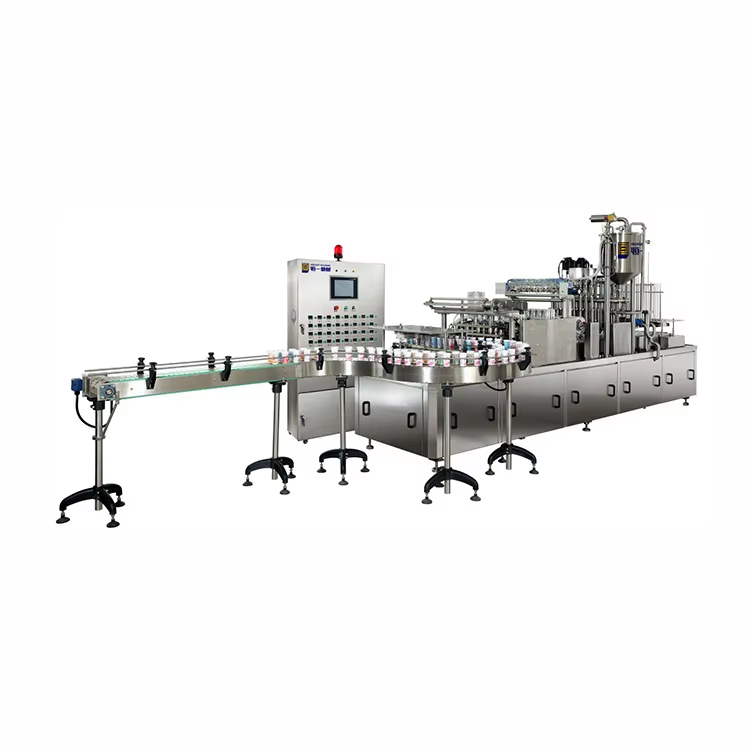
Cup Filling Sealing Machine: Practical Strategies for Increasing Production Speed Without Sacrificing Quality
A dairy plant running 8,000 cups per hour faces a math problem when demand doubles: add a shift, buy another machine, or find more speed from the existing line. Increasing throughput of a cup filling sealing machine often yields the highest return — but only when approached methodically. Pushing past design limits without understanding constraints produces more rejects, more downtime, and lower output.
Understanding the Speed Constraints on a Cup Filling Sealing Machine
Where Bottlenecks Actually Occur
Production speed is not determined by the conveyor motor. The bottleneck is the slowest station — de-nesting, filling, sealing, or discharge. Viscous products often make filling the constraint; film dwell-time requirements often make sealing the constraint. Identifying the limiting station requires timing each sub-cycle independently on a cup filling sealing machine.
The Speed-Quality Relationship
Every cup filling sealing machine has a stable quality range and a threshold beyond which defects rise. As cycle time decreases below minimum dwell time, seal strength drops — gradually at first, with a 5% dwell reduction only reducing peel strength 2-3%. Below a critical threshold, seal quality collapses because the heat-seal layer never activates. Testing with actual product and film is essential — not relying on the manufacturer's maximum rated speed.
A Real-World Case: Sauce Producer's Throughput Optimization
The Capacity Crunch
A hot sauce producer in Central America faced 40% more orders after securing North American retail distribution. Their cup filling sealing machine — a four-head HZF model at 3,200 cups per hour — could not meet demand even with overtime. A second machine would require six months and major capital. The team chose optimization first.
How Incremental Improvements Doubled Effective Output
Rather than replacement, the team reduced non-productive time. The de-nesting stroke was shortened by 8mm, saving 0.15 seconds per cycle. Filling switched from single-stage to two-stage — fast bulk fill followed by slow precision top-off — cutting fill time 18% while maintaining accuracy. Sealing temperature was raised 3°C after peel testing, allowing 0.1-second dwell reduction. Combined, throughput rose from 3,200 to 4,200 cups per hour — a 31% gain. The cup filling sealing machine, supplied by Shantou Higheasy Machinery Co., Ltd., had the mechanical headroom because its HZF-series design included adjustable strokes and multi-stage filling as standard.
Technical Approaches to Speed Optimization
Multi-Stage Filling and Nozzle Configuration
Single-stage filling is slower because the nozzle stays in the cup for the full dosing duration. Two-stage systems fill 80% at high speed, then slow for the final 20% to achieve accuracy — the bulk fill needs no precision. Piston fillers, gear pumps, and volumetric systems on a cup filling sealing machine can all be configured for multi-stage operation. For products with particulates, nozzle diameter must pass the largest particle without bridging.
Indexing Speed and Motion Profile Optimization
The indexer that moves cups between stations can be accelerated without affecting quality — if acceleration and deceleration profiles are tuned correctly. Servo-driven indexers offer software-adjustable motion profiles, unlike mechanical cams. The goal is minimizing dwell-to-dwell time without cup sloshing. For liquids, limit acceleration to prevent spillage; for solids, higher rates are acceptable on a cup filling sealing machine.
Practical Guidance for Production Speed Improvement
Before increasing throughput, collect baseline data for one full shift: cycle time per station, reject rate by defect, downtime by cause. Identify the slowest station and optimize it first — improving elsewhere delivers zero gain if the bottleneck remains. After each adjustment, run 500 cycles and test seals and fill weight on 50 cups from different positions. Document parameters and quality metrics. If seal variability increases with speed, the sealing station has reached its limit — address it through higher-wattage heating or film preheating on the cup filling sealing machine.
Frequently Asked Questions
What is the fastest speed a cup filling sealing machine can achieve?
High-speed cup filling sealing machine models from Higheasy Machinery range from HZF-20 (21,600 cups/hour) to HZF-50 (60,000 cups/hour). Actual throughput depends on cup size, product viscosity, fill volume, and film type.
Does increasing speed always reduce seal quality?
Not if the increase stays within the operating window. As long as dwell time meets the minimum requirement, seal quality remains stable. Raising temperature can partially compensate but requires peel-test validation on the cup filling sealing machine.
How do I determine which station is the bottleneck on my cup filling sealing machine?
Time each station independently over 50 cycles. The station with the longest average is the bottleneck. Higheasy Machinery's PLC-controlled cup filling sealing machine systems display per-station cycle times directly.
Can product formulation changes improve filling speed?
Yes. Reducing viscosity through temperature adjustment can shorten fill time significantly. Heating viscous products by 5-8°C before filling can reduce dosing time 15-25% on a cup filling sealing machine.
What maintenance is most critical for maintaining high-speed production?
Sealing jaw alignment, thermocouple calibration, and nozzle cleanliness are the top three. Misalignment causes defects increasing with speed; drifting thermocouples compound at shorter cycles. Clean nozzles prevent partial blockages on a cup filling sealing machine.
Is it better to buy a faster machine or optimize an existing cup filling sealing machine?
Optimization comes first — it costs far less than new equipment and often reveals untapped capacity. When diminishing returns set in, upgrading to a higher-speed cup filling sealing machine from suppliers like Shantou Higheasy Machinery becomes the logical next step, informed by real production data.
Table of Contents
- Cup Filling Sealing Machine: Practical Strategies for Increasing Production Speed Without Sacrificing Quality
- Understanding the Speed Constraints on a Cup Filling Sealing Machine
- A Real-World Case: Sauce Producer's Throughput Optimization
- Technical Approaches to Speed Optimization
- Practical Guidance for Production Speed Improvement