
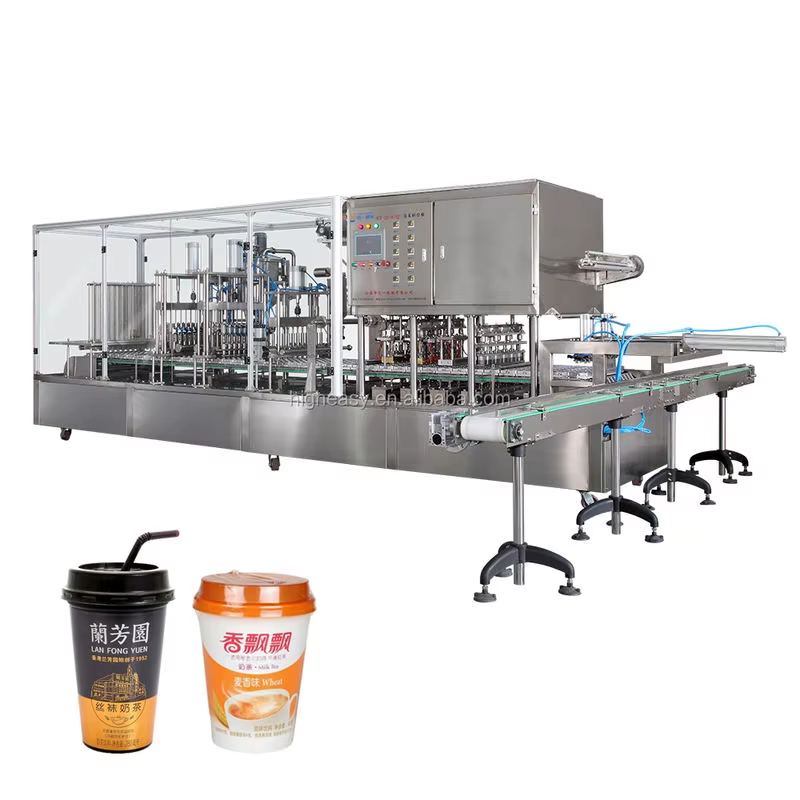
Cup Filling Sealing Machine: How Intelligent Design Meets Food Hygiene Standards
When a sealed yogurt cup leaves a production line, the consumer trusts that every gram inside is safe. Achieving that trust requires more than a clean factory floor — the packaging equipment itself must eliminate contamination risks at every step. A well-designed cup filling sealing machine integrates material science, automation controls, and hygienic engineering to meet international food safety standards without slowing throughput.
Understanding Food Hygiene Risks in Cup Filling Operations
Contamination Pathways in Cup Filling Operations
Food contamination during cup filling happens through three main routes: airborne particles entering the cup during transit, microbial growth on machine surfaces that contact product, and seal failures that expose contents after packaging. A quality cup filling sealing machine addresses all three by enclosing the filling zone, using non-porous construction materials, and monitoring seal integrity in real time. The difference between a basic filler and a hygiene-compliant system often comes down to whether the equipment was engineered with food safety as a primary design goal, not an afterthought.
How Food-Grade Material Construction Prevents Microbial Growth
Stainless steel 304 (SS304) remains the industry standard for a cup filling sealing machine because its smooth, non-porous surface resists bacterial adhesion and withstands repeated exposure to cleaning chemicals. Unlike painted carbon steel or plastic contact parts that develop micro-scratches over time, SS304 holds its surface integrity through thousands of CIP cycles. A single non-compliant component can compromise the entire line.
A Real-World Case: Dairy Producer's Hygiene Upgrade
The Contamination Challenge at a Southeast Asian Yogurt Facility
A mid-sized yogurt manufacturer in Southeast Asia faced recurring quality holds. Their existing cup filling sealing machine used mixed construction materials, and seal consistency drifted after extended runs at ambient temperatures above 30°C. Microbial counts exceeded internal limits approximately once per month, forcing product destruction. The root cause traced back to biofilm accumulation in hard-to-clean joints and inconsistent sealing temperature control.
Results After Switching to a Hygienic Cup Filling Sealing Machine
The facility replaced its line with an HZF-series automatic system built on an SS304 platform with enclosed filling chambers. The new cup filling sealing machine incorporated PID-controlled heat sealing, reducing seal variation to within ±2°C. CIP cycles were programmed into the PLC, eliminating manual cleaning variability. Within three months, microbial-related quality holds dropped to zero, and OEE rose by 14 percentage points from reduced downtime.
Core Technologies That Enable Hygienic Filling and Sealing
CIP Integration and Sealed Filling Chambers
CIP technology turns manual cleaning into an automated, repeatable process. A modern cup filling sealing machine routes cleaning solutions through the same piping and nozzles used for product — all without disassembly. Sealed filling chambers maintain positive air pressure with HEPA-filtered airflow, keeping airborne contaminants out of the zone between cup de-nesting and film sealing. This aligns with ISO 14159 hygienic machinery design principles, where preventing contamination at the source is preferred over detecting it later.
Precise Temperature Control and Seal Verification
Heat sealing operates on a narrow window: too low and the film peels open; too high and it burns through or creates micro-channels. PID controllers on a cup filling sealing machine adjust heating output continuously based on thermocouple feedback, not simple on-off cycles. Combined with photoelectric film registration that verifies lid alignment before sealing, these controls ensure hermetic closure. For high-acid products like fruit juice or yogurt, seal integrity directly determines shelf life.
Practical Selection and Operation Guidance
When evaluating a cup filling sealing machine for hygiene-critical applications, look beyond the spec sheet. Request cleanability validation — swab test results from hard-to-reach zones after CIP cycles. Ask about sealing head temperature uniformity across its full width, as edge-cooling can create weak spots on outer positions. Schedule quarterly seal-bar inspections and annual replacement of food-contact gaskets and O-rings, even if they appear intact.
Frequently Asked Questions
What food safety certifications should a cup filling sealing machine have?
A cup filling sealing machine should carry CE marking and ISO 9001 certification. For dairy, look for 3-A Sanitary Standards or EHEDG compliance. Shantou Higheasy Machinery Co., Ltd. produces HZF-series machines meeting CE and ISO 9001 requirements, with SS304 construction suitable for yogurt, juice, and sauce.
Can a cup filling sealing machine handle both liquid and solid products?
Yes. Many machines support multiple product types through interchangeable filling heads — piston pumps for liquids, volumetric fillers for free-flowing products, and auger systems for powders. Higheasy Machinery provides customizable filling configurations on their HZF-series cup filling sealing machine models.
How does HEPA filtration improve cup filling hygiene?
HEPA filters remove 99.97% of particles 0.3 microns and larger. When integrated into a cup filling sealing machine, this creates a clean microenvironment around cups as they travel from de-nesting to sealing.
What cleaning frequency is recommended for a cup filling sealing machine?
Daily end-of-shift CIP cycles are standard for dairy lines. Low-acid, shelf-stable products may extend to 48 hours. CIP-capable systems from Higheasy Machinery automate wash-rinse-sanitize cycles, reducing labor and validation time on their cup filling sealing machine installations.
Why does sealing temperature consistency matter for food safety?
Temperature variations exceeding ±3°C create weak bonds that fail during distribution. A cup filling sealing machine with PID-controlled heating elements maintains consistent temperature, critical for products requiring ambient shelf life without preservatives.
How do I verify seal integrity on a running cup filling sealing machine?
Random sampling with vacuum decay or dye penetration testing provides seal quality data. Modern cup filling sealing machine systems from Higheasy Machinery also offer inline inspection modules that check seal quality through pressure differential or visual imaging at production speed, rejecting defective cups automatically.