
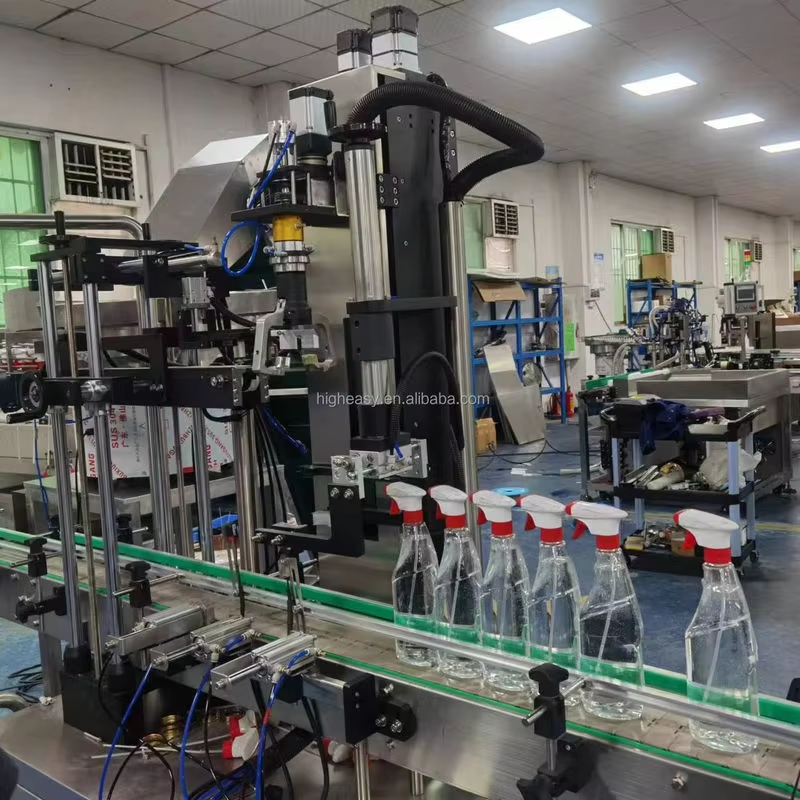
Evaluate Scale of Production and Level of Automation
Differences between semi automatic and fully automatic sount pouch filling and capping equipment
When evaluating semi automatic and fully automatic machines, consider how much production volume is necessary. Semi automatic machines will run around 10-20 pouches per minute which is sufficient for new businesses and businesses with lower volume niche products. Semi automatic machines also offer finger controls around capping and filling which allows more control during the process and offers less monitoring by the operator. While the costs for semi automatic machines is lower, the labor costs, and costs for monitoring, will prove higher. Fully automatic machines, however, run much faster, from 40 to 100 pouches per minute, as a result of a continuous motion design. Fully automatic machines also reduce up to 80% of manual work. If a production goal is to produce more than 20,000 pouches then fully automatic machines will provide better ROI despite higher initial costs. If a growth goal for the business is more than 15% then more automation will also be necessary, which justifies the higher costs for more initial automation.
Existing Lines Integration: With Fillers, Conveyors, and MES
The seamless integration depends on three factors:
- Mechanical interfacing: Ensure conveyor heights and widths marry your pouch (±2 mm tolerance) and that filler discharge points are perfectly matched to nozzle positions
- Control system integration: Ensure the new machinery and your Manufacturing Execution System (MES) supports real-time Overall Equipment Effectiveness (OEE) tracking using OPC-UA or Ethernet/IP
- Data capture: To comply with FDA 21 CFR Part 11 electronic record requirements, we need to capture fill weight, cap torque, seal temperature, and other key parameters at a rate of ≥99%
For factory acceptance testing (FAT), use your actual pouches and products, as post-installation hiccups are often found with dimensional mismatches. Select vendors with flexible modular designs that allow for adjustment as throughput requirements increase, to avoid the need for new line reconfiguration.
Evaluate Key Performance Indicators for Consistent Outcomes
Filling Speed and Capacity: Aligning CPM with Daily Spout Pouch Volume Goals
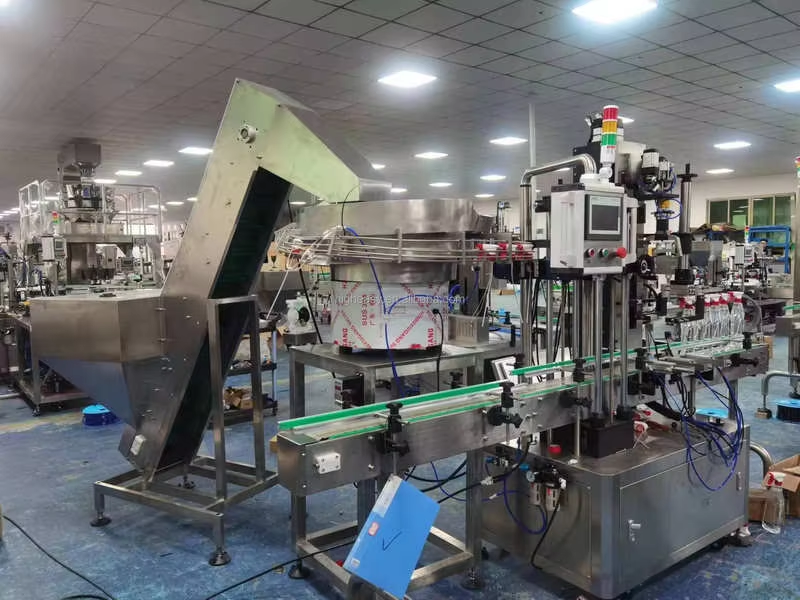
Achieving the correct cycles per minute (CPM) for a spout pouch filling and capping machine is critical for matching it with daily production. If we underspec, the entire line is bottlenecked and has to operate at a slower speed. If we overspec, it's just a high initial investment with maintenance costs. The best approach is to take the daily pouch requirement and divide that by the number of operational hours in a day. Then target machines that are at 85 to 90 percent of that value. Optimize packaging in order to minimize breaks in critical seal. Finally, the maintenance reports from packaging plants suggest that equipment failure is reduced during peak periods when operated within those limits.
Shelf-Life Assurance for Seal Integrity (99.8% Pass Rate) and Fill Accuracy (±0.5%).
When company fill accuracy is below plus or minus 0.5% and falls short on fill accuracy, compliance is a significant concern and so is monetary loss, especially in the case of nutraceutical or pharmaceutical products. If seal integrity is below 99.8% the product will not have a long shelf life. Research conducted in packaging in 2023 found that bad seals were responsible for 23% of excess spoilage cases. New seals and fill accuracy technologies combat this with the use of mass flow metering for thick products and pressure sensitive cap torque sensors. These technologies prevent leaks, reduce oxidation moisture, and control moisture. Companies that operate under FDA stability guidelines, these benchmarks | FDA guidelines | direct control of quality these benchmarks control the quality of the products | etc. These benchmarks protect the quality of the product.
Verify Product and Pouch Compatibility Across All Relevant Physical and Legal Parameters.
When choosing a machine for filling closure of spout pouches filling and closure machine, the first consideration should be the physical and legal alignment analyses to prevent significant loss. Incompatible material tolerances and certifications eliminate the risk of product returns and compliance breaches.
Viscosity-based Nozzle and Pump Selection: Choices include Peristaltic, Piston, and Mass Flow
The viscosity level identifies the optimum filling technology. For liquid products of around 1 to 50 centipoise viscosity, peristaltic pumps are excellent as they provide a continuous and smooth flow (without any pulsation problems) as required for water-based beverages. Piston pumps are preferred for viscous products such as honey and syrup, from about 5,000 to 25,000 cP, as they can deal better with the higher resistance. For very viscous emulsions or suspensions above 10,000 cP (where shearing may disrupt the product structure), Coriolis mass flow meters are excellent as they provide a very precise (±0.3%) measurement while preserving the product structure. It has been reported that 42% of all filling issues are linked to using the wrong pump for the given viscosity level. To minimize the risk of such issues, many companies have started to perform laboratory-scale flow tests during the research phase, as this allows them to identify viscosity pump mismatches before they encounter sealing issues and/or inconsistent dosage during the production process.
FDA/EC 1935 Certification, CIP Integration, and 316L Stainless Steel Compliance with Hygienic Design
Regarding the food processing and pharmaceutical industries, safety demands clean equipment, but it is also a good practice. It is industry practice to use 316L stainless steel to construct equipment with a surface finish no greater than 0.8 micrometers Ra. Additionally, equipment corners cannot exist which allow gathers of contaminants. Equipment also needs to support reliable Clean-in-Place system so that is it maintenanced easily. The absence of these conditions pose substantial risks. Non-compliant machines can cause up to 28% of recalls in the pharmaceutical industry. Surprisingly, the machines in question lack FDA 21 CFR Part 117 or EC Regulation 1935/2004 certifications, which means that they cause the contaminants in the drugs. For the best defense against microbes, the manufacturing machines should feature spouts that have independent lab steam sterilization approval. Other components welded
Most of the time the spout pouch filling and capping machines are able to fill and cap approximately 10 to 20 pouches in a minute.
When should a business think about switching to fully automatic machines?
Automatic machines are suitable for businesses that are currently producing more than 20,000 pouches a day or are predicted to grow more than 15% annually.
What considerations help to ensure a smooth integration with existing production lines?
Seamless integration is mostly attributed to ease of mechanical interfacing, compatibility of control system protocols, and tier granularity of data for parameter tracking.
Why is it critical that pumps are viscocity specific?
Selecting the correct pump based on viscosity is key to avoiding filling, sealing, and production dosage balance issues.
What are the hygiene design standards for filling machines of spout pouches?
Filling machines of spout pouches must be constructed of 316L stainless steel, must have efficient Clean-in-Place systems, and must be FDA/EC compliant to ensure high hygiene standards.