
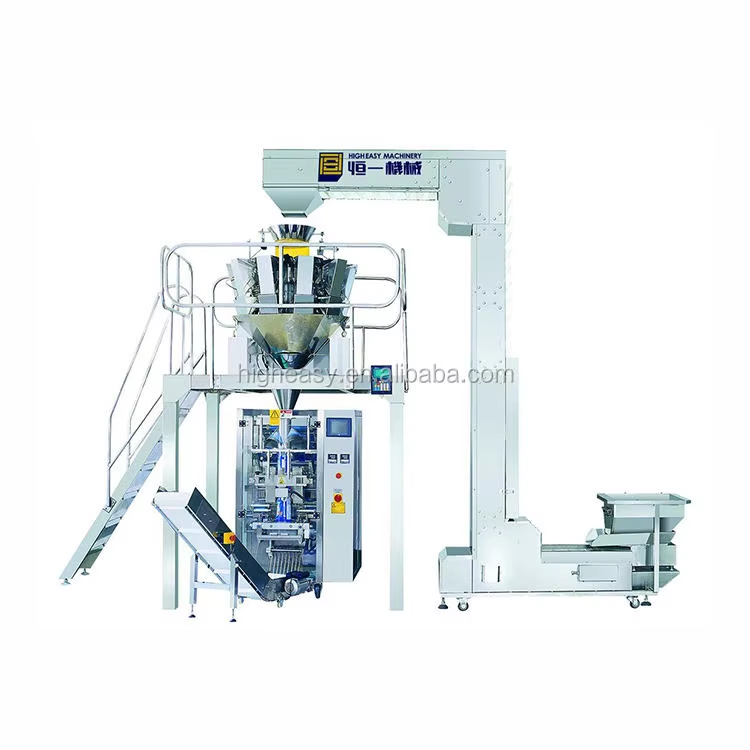
Tracking & Control of Precision Registration of Films
Registration of Films via Eye Mark Detection & High-Speed Photoelectric Sensors
The vertical Form Fill Seal machines (vFFS) provide excellent precision in the formation of bags due to their ability to scan registration marks over 200 times per second and make corrections to the forming module's position in less than 5 milliseconds (faster than a human reaction time). Correct visual alignment of the printed graphics with the transverse seal is maintained to within 0.5 mm. This life system avoids unwanted shifts of images, controls the consumption of the film, and facilitates consistent operation of the machine even at the maximum productivity of 120 bags per minute.
Closed-loop correction and edge-guidance sensors keep the film in the same location.
Infrared edge sensors provide lateral film drift control by detecting the location of the film edge and reporting the location to the PLC system. What happens next? The closed-loop system obtains the information and adjusts the guide rollers and tension settings. Further refinement of the system is achieved by dynamic braking systems which detect and correct small drifts of the film as the film unwinds. Pneumatic actuators provide adjustment capabilities in the order of microns. The feedback system is also important in this system as it reports position information at 10 Hz. All of these mechanisms provide alignment over long production periods in the order of 0.3 mm. The end result is elimination of sealing problems due to film drift during production.
Motion control using rotary encoders and servo drives.
Vertical FFS machines utilize highly accurate systems to ensure that the same amount of film is used in the same position to create the same amount of production errors.
Timed forming collars, synchronized servo drives, and rotary encoder bag length control.
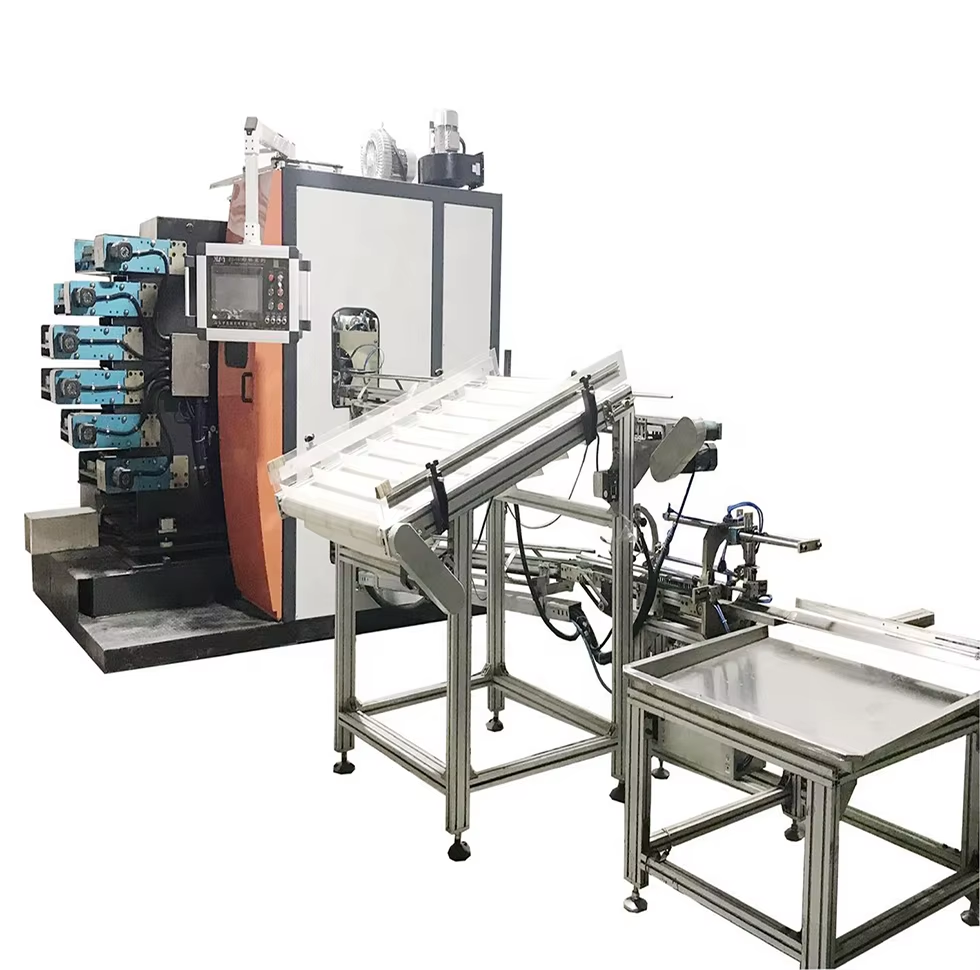
Our servo motors maintain precision control of speed throughout the film processing. Further, the rotary encoders detect shaft rotational position thousands of times each second. The impressive factor is the merging of rotation data with forming collar position data. This allows for exceptionally uniform lengths of bags produced, with a variance of only half a millimeter across the entire batch. In situations where the production process requires sudden rests and starts, the high-torque servos facilitate smooth movement without jerking. During the process, deceleration and rapid motion of the forming collars are controlled and adjusted by the motion control system based on real-time encoder data. Precise production allows us to optimize the use of packaging material, reducing the consumption by 15% in most of the cases.
Sealing position and cut-off timing adjustments are done through PLCs in a closed-loop system.
The PLC recognizes the location of the thermal seal bars and when the blades are cut and then compares these with the expected location of the seal bars and the cut timing. System adjustments are made for any positions outside the +/- 0.3 mm range. The seal bar positions and cut timing are adjusted dynamically in response to changing film tension. The PLC uses PID algorithms calibrated to the millisecond to control the timing of the blades. The PLC accounts for thermal expansion of the temperature sensors so the seal is kept tight and completely air impermeable. Error rates in these systems typically fall under 0.1%. The Packaging Automation Institute presented research in their 2023 report and stated positional adjustments from these systems have increased production throughput by 20%.
Mechanical Stability: Forming Collar, Tube Alignment, and Tension Control
Forming collars of optimized geometry and alignment of vertical tubes ensure minimal film drift
Well-designed and appropriately shaped turning forming collars facilitate accurate conversion of a planar film to a tube without any deformities. Laser systems for vertical alignment keep everything aligned with the jaws and stop lateral shifts that cause misalignments of printed graphics and unsealed pouch seals. Tests have shown that position variations are reduced by over 92% with shaped collars. Such precision is critical in high-speed applications where a variation as small as 0.5 mm can cause total pouch structure failure.Controlling unwinding rollstock tension and skew alignment during vertical travel of the film
Throughout vertical travel of the film, servo-controlled brakes ensure constant tension control and adjust automatically with speed and diameter changes of the film rolls. Specialized load cells detect changes in a limited range with active corrections up to 1000 times per second. Infrared guides compensator infinitely correct the material’s sideways drift prior to reaching the area of the anticipated shape. The combination of both systems compensates for humidity-related stretching of the film and eliminates the appearance of wrinkles. For the given design, the manufacturer is able to provide the production capacity of more than 200 pouches per minute with no effort.
FAQ
What is the purpose of precision film tracking?
Precision film tracking ensures maintenance of proper alignment of the film, correct positioning of the film, alignment of graphics, accuracy of seals, and ultimately works towards minimizing film waste and maximizing production efficiency.
How do edge-guidance sensors function?
Edge-guidance sensors track the lateral position of the film and communicate this data to a PLC system to make real-time adjustments to the film's position and stability.
What is the function of the servo motors in an in FFS machine?
The servo motors control the movement of the film and ensure that a bag is of a consistent length and that there is a reduced loss in production caused by the ability to shift and adjust the movement of the film based on the encoder.
Why is mechanical stability important in FFS?
Sufficient mechanical stability is needed to keep the film correctly aligned, to maintain the correct tension of the film, and to avoid mechanical drift and distortion in order to achieve accurate packaging while maintaining a high rate of production.