
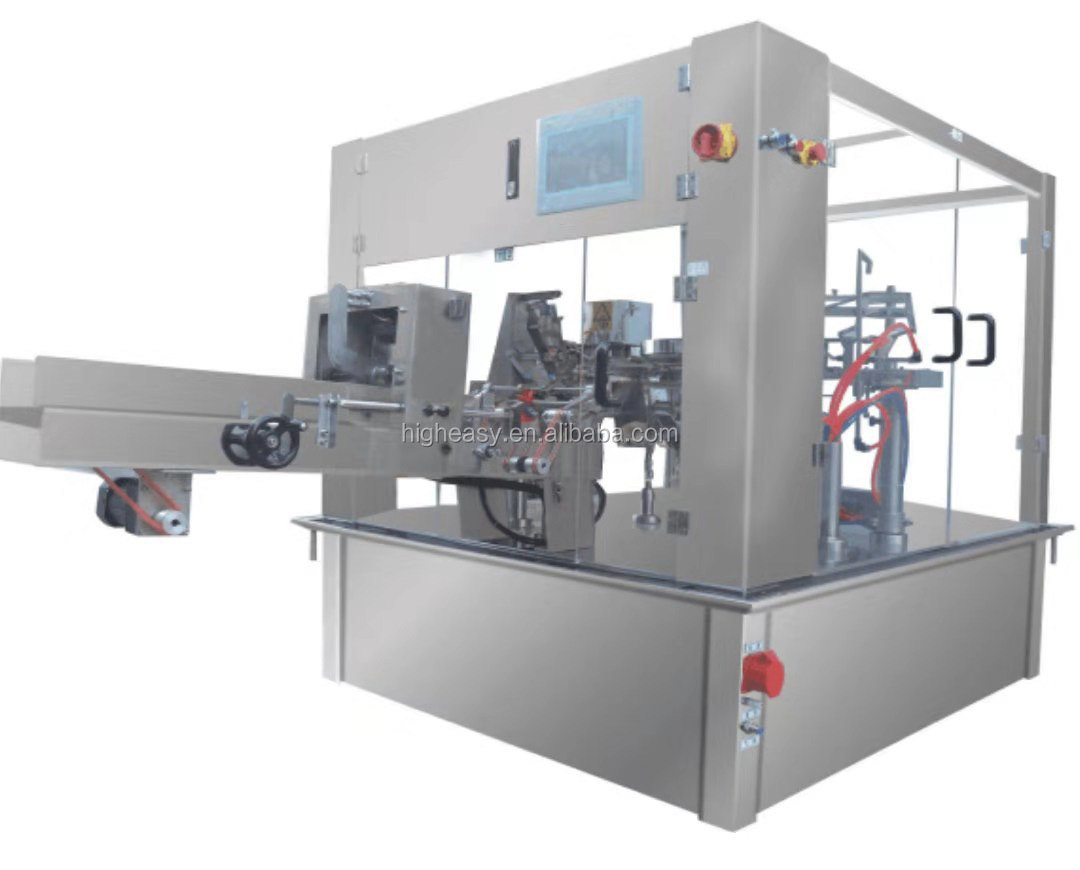
How a Premade Pouch Filling Sealing Machine Works
A premade pouch filling sealing machine takes ready-made pouches — stand-up, flat, zipper, or spouted — and automates opening, filling, and sealing at production speed. Unlike form-fill-seal machines creating pouches from roll stock, these machines work with pouches manufactured offline, typically with more complex features: resealable zippers, shaped die-cuts, spouts. The trade-off is handling a pre-formed pouch rather than continuous film, demanding a fundamentally different mechanical approach.
Pouch Handling, Filling, and Sealing Stations
A rotary premade pouch filling sealing machine uses a rotating carousel with multiple stations carrying grippers that hold pouches by their edges. A suction arm picks pouches from the magazine. A sensor verifies presence and orientation. Compressed air or vacuum-assisted mechanisms open the pouch mouth. The filling station dispenses product — liquid, powder, granule, or solid — through a nozzle. A vibratory settling unit compacts before sealing. The sealing station closes the pouch top with heat-seal bars fusing the inner PE layer of the laminate.
Real-World Case — A Coffee Roaster Adds Vacuum Capability
An Italian specialty coffee roaster packaged whole beans in 250-gram stand-up pouches using a standard premade pouch filling sealing machine with heat-seal-only capability. Shelf life at retail was approximately 4 weeks before noticeable flavor degradation — insufficient for export markets requiring 8 to 12 weeks. The roaster upgraded to a two-stage sealing station: vacuum-assisted nitrogen flush to displace headspace oxygen, followed by immediate heat sealing. Headspace oxygen dropped from 21% to below 2%. Shelf life extended to 10 to 12 weeks. The machine cost increment for the vacuum/gas-flush station was approximately 15%, recovered through reduced returns and export market entry.
Vacuum Sealing and Modified Atmosphere Packaging
Vacuum vs. Gas Flush — Two Approaches to Oxygen Removal
A premade pouch filling sealing machine reduces oxygen through two methods. Vacuum-assisted sealing draws a partial vacuum in the pouch headspace before seal bars close, physically removing air. This suits solid, non-fragile products — coffee beans, nuts, hardware — where the pouch can partially collapse without crushing contents. Gas flushing — modified atmosphere packaging (MAP) — injects inert gas (nitrogen or CO₂) into the headspace, displacing oxygen without creating a vacuum. This is preferred for fragile products — chips, baked goods — that would be crushed by vacuum. Some configurations offer both in sequence — vacuum to remove ambient air, followed by nitrogen injection — achieving residual oxygen below 1%.
Machine Configuration for Vacuum-Sealed Pouches
Seal Bar Design, Chamber Requirements, and Film Compatibility
Adding vacuum capability requires a seal chamber — a hood descending over the pouch top before the vacuum cycle. The chamber seals against the pouch using a soft silicone gasket. The vacuum pump — rotary vane or liquid ring — must achieve the target level (typically 50 to 100 mbar absolute) within the machine’s cycle time. If the pump cannot evacuate within the rotary station’s dwell time, line speed must be reduced. Film compatibility is equally important: the pouch laminate must include a barrier layer — aluminum foil, EVOH, or metallized PET — to prevent oxygen re-entering through the film. The inner seal layer must be contamination-tolerant because any product residue in the seal zone creates leak paths.
Evaluating Vacuum Sealing Capability
Five Questions to Ask Before Specification
First, what residual oxygen level does the product require? Coffee and nuts target below 2%; fresh meat below 0.5%. Second, is the product crushable? If yes, gas flush is needed. Third, can the vacuum pump evacuate the chamber within the target cycle time? Fourth, does the pouch laminate include an appropriate barrier layer? Fifth, is the seal area protected from product contamination during filling, since powder or liquid residue in the seal zone creates leak paths regardless of vacuum quality? A premade pouch filling sealing machine with vacuum capability is an integrated system — the sealing station, pump capacity, pouch film, and filling station design must be specified together.
Frequently Asked Questions
Can a premade pouch filling sealing machine perform vacuum sealing?
Yes, a premade pouch filling sealing machine performs vacuum sealing when equipped with a seal chamber, vacuum pump, and control sequencing vacuum evacuation before heat-seal closure. This suits solid, non-fragile products.
What is the difference between vacuum sealing and gas flushing?
Vacuum sealing physically removes air from the headspace. Gas flushing injects inert gas to displace oxygen without vacuum. Vacuum suits non-fragile solids; gas flush suits crushable products. Combined, they achieve residual oxygen below 1%.
What residual oxygen level can be achieved?
A properly configured premade pouch filling sealing machine with vacuum and gas flush achieves residual oxygen below 2%, and below 1% with optimized sequencing, depending on pump capacity and seal integrity.
What pouch films are required for vacuum-sealed packaging?
Vacuum-sealed pouches require a barrier layer — aluminum foil, EVOH, or metallized PET — and a contamination-tolerant inner seal layer (LLDPE or metallocene PE) to prevent leakage from product residue in the seal zone.
Does adding vacuum capability reduce machine speed?
It can if the vacuum pump cannot evacuate the chamber within the station’s dwell time. The premade pouch filling sealing machine pump capacity must be matched to chamber volume and target cycle speed.
How does vacuum sealing extend product shelf life?
Vacuum sealing removes oxygen that drives lipid oxidation, mold growth, and bacterial spoilage. Coffee packaged below 2% headspace oxygen maintains flavor for 10 to 12 weeks versus 4 weeks in ambient-air-sealed pouches.